Seawall repair in Daytona Beach and coastal Volusia County
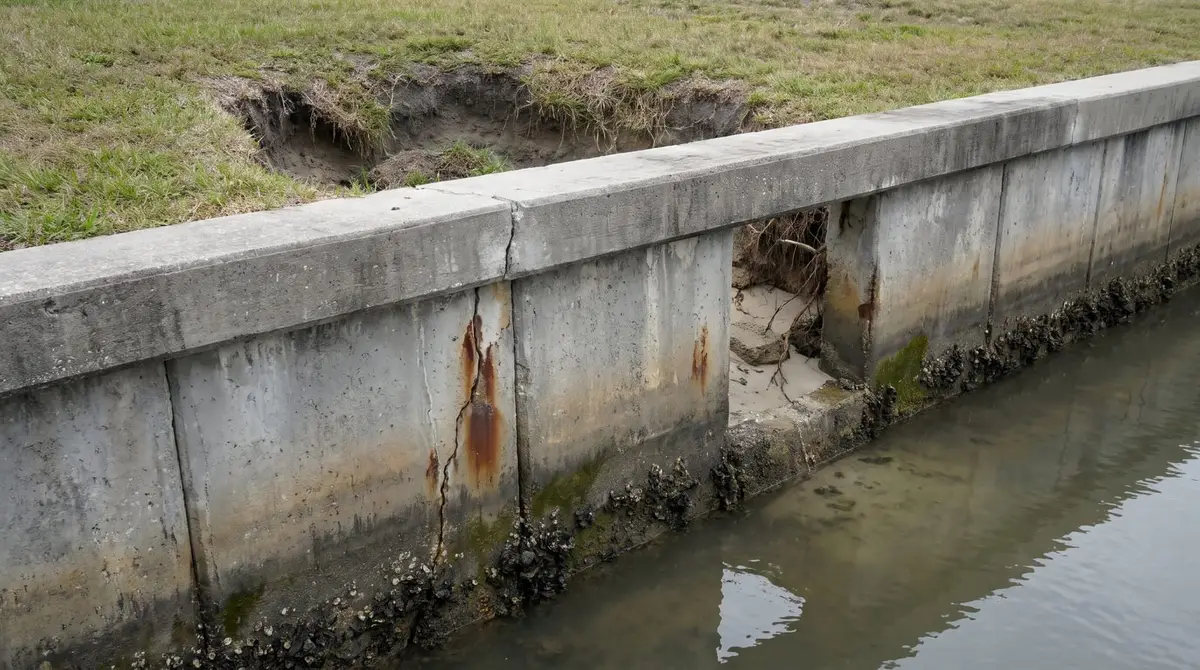
Most seawalls fail slowly and from behind. Soil leaks out through a joint a little with every tide, and the first thing you see is a dip or a hole in the yard a few feet from the wall. Caught at that stage, a wall can usually be repaired for $100 to $250 a foot instead of replaced.
Call (386) 333-6570Rather not call? Send the detailsCalls are answered weekdays, 9 to 6. After hours, leave your name, address and what's going on, and you'll get a call back first thing the next business day.
What are the warning signs of a failing seawall?
A seawall owner's manual from a Florida city building department lists the same few symptoms again and again. Walk the wall at low tide and look for these:
- Holes or dips behind the wall: Sinkholes in the yard mean soil is washing out through a joint or under the wall.
- Fill showing on the water side: Sand or backfill visible at the panel joints on the canal side, easiest to see at low tide.
- Rust on the cap or panels: Rust stains and cracks mean salt water has reached the steel inside the concrete or the tiebacks.
- Panels leaning or wavy: Panels tilting out, a cap that has rotated, or a gap opening between the wall and the dock.
- Cracks along the waterline: Cracks with rust marks on the water side of the panels, where the wall is wet and dry with every tide.
One small dip after a storm is worth watching. A hole that comes back after you fill it, or rust spreading along the cap, means the wall needs a closer look.
Why do seawalls around Daytona fail?
After Hurricanes Ian and Nicole in 2022, Florida's environmental agency surveyed the oceanfront walls in Volusia County. About 154 seawalls and revetments were destroyed or badly damaged, and 4.2 miles of them were damaged in all. Ian's storm tide reached about 8 feet at Daytona Beach.
The report is blunt about why. Most of the walls destroyed in Daytona Beach, Daytona Beach Shores and Wilbur-by-the-Sea were more than 30 years old, with corroded steel, inadequate tiebacks, panels too short or too thin, and no proper filter drainage behind the wall. Those were beachfront walls, but river and canal walls age the same way.
Water level matters too. The Halifax River is a 23-mile tidal lagoon behind the barrier island, and the tide inside it is gentle up north: NOAA puts the average range at about 0.59 feet at Ormond Beach, against 2.75 feet near Ponce Inlet. Walls closer to the inlet see more tide moving in and out of every joint.
How is a seawall repaired?
The fix depends on where the wall is failing. The common repairs are:
- Seal the joints: Gaps between panels are cleaned and sealed, and filter fabric goes back in so soil stays put.
- Fill the hollows: Pressure grouting fills the voids behind and under the wall, and the yard is regraded on top.
- New anchors or tiebacks: Rusted tieback rods are replaced, or new anchors are added, so the wall can't tip outward.
- A new cap: A cracked, rusting cap is formed and poured again with new steel.
- Rock at the toe: Riprap placed along the bottom of the wall stops the base from washing out.
Weep holes, the small holes above the waterline that let water drain out from behind the wall, should be cleared at the same time. Blocked weep holes let pressure build up behind the panels.
How much does seawall repair cost?
Angi's 2026 national figures put seawall repair at about $100 to $250 a linear foot, so roughly $10,000 to $25,000 for a 100-foot wall. Sealing and grouting joints sits at the low end; fixing a leaning wall runs $200 to $600 a foot, and replacing cracked panels $450 to $600. A new cap with tiebacks is about $125 to $230 a foot.
Angi's rule of thumb: if repairs come close to half the cost of a new wall, replacing it is often the better buy. See seawall replacement and the cost guide.
Does seawall repair need a permit?
Repairing or rebuilding a seawall on its old line, or no more than 18 inches in front of it, is exempt from a state environmental permit under Florida Statutes 403.813. That exemption does not cover walls on the ocean beach, which need a state coastal permit, and it never replaces the local building permit. The permits guide walks through each step.
Common questions
Can I just fill the hole behind my seawall?
You can, but it will come back. The soil is leaving through a gap in the wall, so the gap has to be sealed and the hollow filled from behind, or the new fill washes out with the next tides.
How long does a seawall last?
HomeGuide gives concrete seawalls about 30 to 50 years and vinyl 50 to 60. A poorly built or neglected wall can need repairs in 10 to 20.
Who should repair a seawall?
A contractor who does marine work. Florida offers state certification for seawall, bulkhead, dock and pile-driving work; you can look up any contractor's state license on the state's license search.
Sources: City of Key Colony Beach, FL, Seawall owner's manual (2022) (source); Florida DEP, Hurricane Ian and Nicole post-storm beach conditions report (revised Aug 2023) (source); St. Johns River Water Management District, Halifax River project (2019) (source); NOAA tide datums, Ormond Beach, Halifax River (8720954) (source); NOAA tide datums, Ponce Inlet, Halifax River (8721138) (source); Angi, How much does it cost to repair a seawall? (Oct 2026) (source); HomeGuide, Seawall cost (lifespan by material) (source); Florida Statutes 403.813, permits not required (2026) (source); Florida Statutes 553.79, building permits (2026) (source); Florida DBPR, License search (source).
Last reviewed November 1, 2026.
Rather not call? Send the details
A local seawall and dock pro will call you back.